
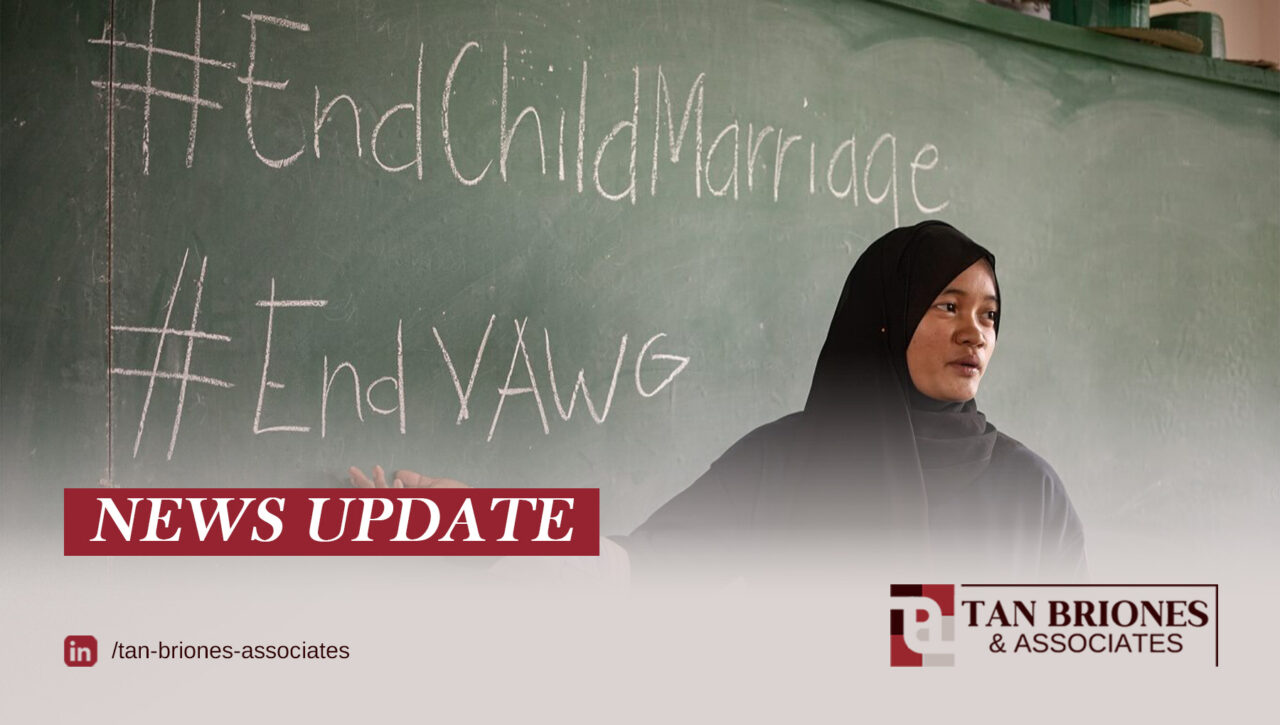
The Philippine government launched a four-year National Action Plan aimed at ending child, early, and forced marriages and unions, seeking to strengthen the implementation of the country’s 2021 ban on child marriage and boost protection for vulnerable children who remain at risk despite the law.
The National Action Plan to End Child, Early, Forced Marriages and Unions (CEFMU) for 2025–2028 lays out coordinated measures to prevent child marriage, strengthen child protection and referral systems, and provide support to children already affected by early or forced unions.
It also seeks to address social norms and structural barriers that allow the practice to persist, with children and adolescents involved in shaping the plan’s priorities.
The action plan was developed by the government through the Council for the Welfare of Children (CWC) and the Department of Social Welfare and Development (DSWD), in partnership with UNICEF, the United Nations Population Fund (UNFPA), and the Philippine Legislators’ Committee on Population and Development (PLCPD).
CWC Executive Director Angelo Tapales said the action plan reinforces a whole-of-government and whole-of-society approach to ending the practice.
“By transforming harmful social norms, enhancing social services, and empowering communities to take proactive action, it aims to effectively prevent and respond to the adverse effects of early marriage and union on our children,” Tapales said.
Despite the enactment in 2021 of Republic Act No. 11596, the law prohibiting child marriage, stakeholders noted that enforcement, community-based support, and sustained social change remain key challenges.
PLCPD Executive Director Aurora Quilala said laws such as RA 11596 can only improve children’s lives if they are “fully and meaningfully implemented,” describing the national action plan as a key platform to achieve that goal.
UNICEF Philippines Representative Kyungsun Kim said building strong local systems and community engagement is essential to ensuring children can make informed choices and grow up in safe environments where their potential is not cut short.
“Child marriage is a fundamental violation of human rights that robs girls of their childhood, their health, and their agency,” UNFPA Philippines Country Representative Neus Bernabeu stressed, describing the action plan as “a lifeline, a critical bridge between the law and the lived realities of the most vulnerable.”
Data shows that one in ten girls in the Philippines remains at risk of child marriage, underscoring the need to link legal prohibitions with accessible services in health, education, and social protection.
Moreover, stakeholders pointed out that ending child marriage is closely associated with preventing early pregnancy, keeping girls in school, and reducing violence.
For his part, Secretary Rex Gatchalian vowed that the DSWD, as lead implementer of the law, will continue to strengthen policies, train frontline workers, and support children who are vulnerable or already forced into early marriages or unions.
As part of the launch, the local governments of Brooke’s Point, Catbalogan City, and Socorro signed a memorandum of agreement to adopt a systems-based approach to preventing and responding to child marriage.
Follow Tan Briones & Associates on LinkedIn for more legal updates and law-related articles.