
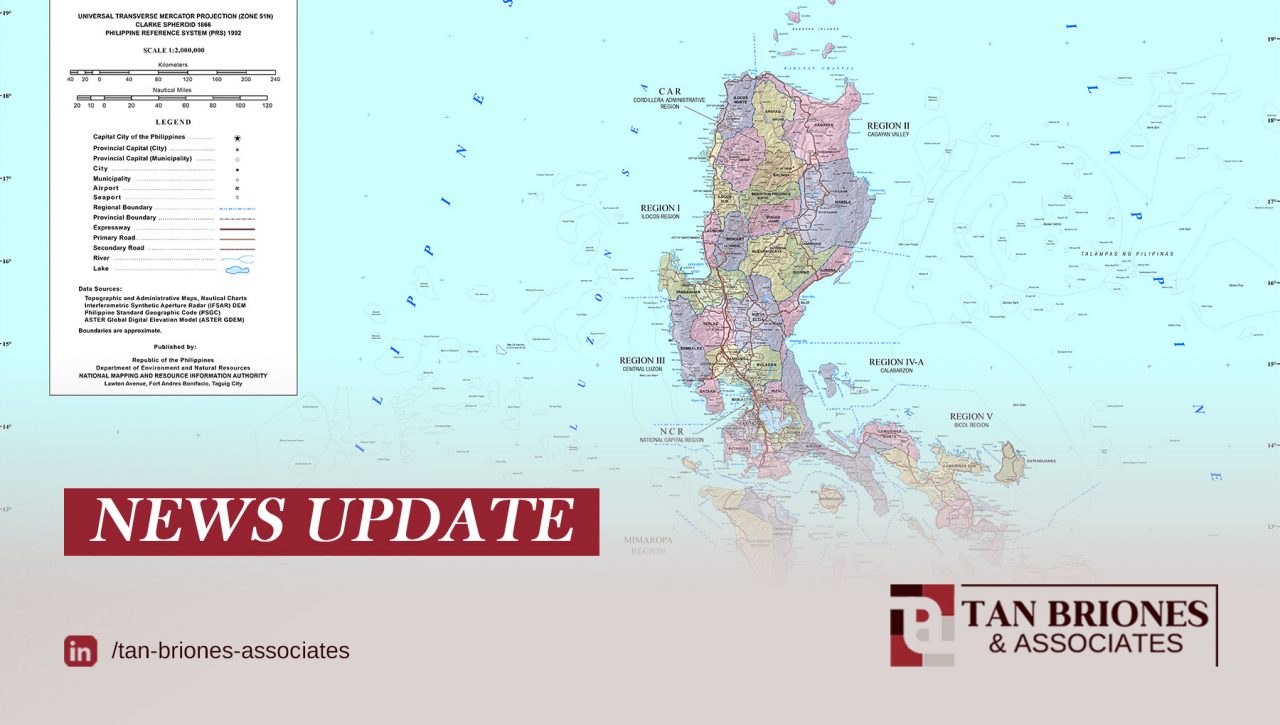
The National Mapping and Resource Information Authority (NAMRIA) has emphasized that the Philippines’ Exclusive Economic Zone (EEZ) is depicted in official maps and nautical charts in accordance with international law.
In a statement, NAMRIA explained that the EEZ extends up to 200 nautical miles from the country’s archipelagic baselines, forming a continuous curved maritime boundary that is represented through precise geospatial data rather than fixed straight-line coordinates.
“This creates a continuous curved boundary, similar to the edge of a circle, not a polygon made of straight lines,” NAMRIA said, warning that simplified representations may lead to technical inaccuracies in defining maritime limits.
The agency said the EEZ is depicted using geospatial data derived from the archipelagic baselines defined under Republic Act No. 9522, allowing navigation systems and mapping software to determine maritime limits accurately.
NAMRIA added that since 2012, the Philippine government has formally adopted the term “West Philippine Sea,” which the agency consistently uses across its administrative, topographic, thematic, and nautical maps.
The agency stressed that official maps and nautical charts are technical reference materials used by mariners, planners, researchers, and institutions for navigation, geographic information, and safety at sea, not political or declarative instruments.
NAMRIA said its nautical charts meet international hydrographic standards and are used by both Philippine and foreign vessels, with the data submitted to international bodies such as the International Hydrographic Organization.
Follow Tan Briones & Associates on LinkedIn for more legal updates and law-related articles.