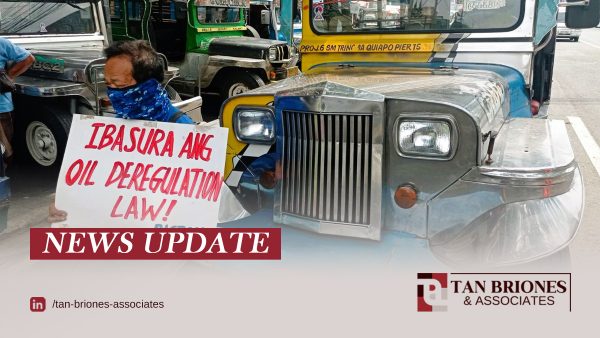

A state of national energy emergency has been declared as Middle East tensions disrupt global oil supply, triggering government measures to stabilize fuel, protect consumers, and sustain economic activity.
Executive Order No. 110, signed on March 24, 2026, responds to heightened geopolitical tensions in the Middle East, including the closure of the Strait of Hormuz, which has disrupted global oil flows and increased volatility in international energy markets, threatening the country’s energy security.
Under the order, the government adopts the “Unified Package for Livelihoods, Industry, Food, and Transport” (UPLIFT) as its central response framework, combining energy supply management and targeted interventions for vulnerable sectors and key industries.
The measure directs the Department of Energy to ensure stable fuel supply through optimization, conservation, and inter-agency coordination, and authorizes action against hoarding, profiteering, and supply manipulation.
To oversee implementation, the order creates the UPLIFT Committee, chaired by the president, with key Cabinet officials tasked to coordinate and monitor response measures.
The committee is mandated to “ensure the continued and orderly movement, supply, distribution, and availability of fuel, food, medicines… and other essential goods,” and to maintain the operation of transport, utilities, healthcare, and other critical services.
Beyond immediate measures, the order directs agencies to reduce dependence on petroleum through renewable energy, promote electric vehicles, and improve energy efficiency.
The Department of Transportation is tasked to roll out fuel subsidies and expand public transport services, while the Department of Social Welfare and Development is to expedite assistance to vulnerable groups. The Department of Trade and Industry is directed to monitor and address price increases in basic goods.
The Department of Agriculture is ordered to secure food supply and support farmers and fisherfolk, while the Department of Migrant Workers is to assist affected overseas Filipino workers. Economic managers, including the Department of Finance and the Bangko Sentral ng Pilipinas, are tasked to monitor inflation, exchange rates, and remittance flows.
Local government units are urged to align with national measures, while the private sector is encouraged to support logistics, adopt energy-saving practices, and ensure fair pricing.
The order will remain in effect for one year unless earlier lifted or extended, and takes effect immediately upon publication.
Follow Tan Briones & Associates on LinkedIn for more legal updates and law-related articles.