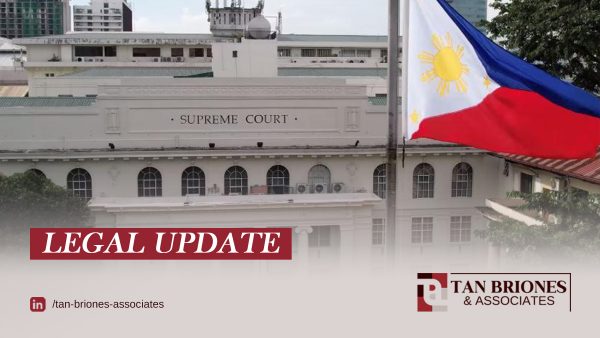


The Supreme Court (SC) has standardized how notices of dishonor may be served in bouncing-check cases, allowing electronic service under specified conditions while requiring an affidavit of service regardless of the mode used.
In a decision penned by Associate Justice Samuel H. Gaerlan, the SC En Banc ruled that notices of dishonor under Batas Pambansa Blg. 22, or the Anti-Bouncing Check Law, should primarily be served personally, but may be sent by registered mail when personal service is impracticable or through electronic means under prescribed circumstances.
“Clearly, regardless of the mode of service employed, the requirement for an affidavit of service of notice of dishonor is now mandatory,” the Court said.
The guidelines were laid down as the SC affirmed the conviction of spouses Arnel and Marivic Carlos on six counts of violating BP 22 over six postdated checks issued to Tire Star, Inc. that were dishonored because their account had been closed. In clarifying its jurisprudence, the Court cited earlier cases involving alleged non-receipt of notices and underscored the need for clear and standardized procedures for establishing the second element of the offense.
PERSONAL SERVICE & SERVICE BY MAIL
Under the rules, personal service is the primary mode and may be made by delivering the notice directly to the drawer. When the drawer transacts or issues the check through a company in the ordinary course of business, the notice may instead be delivered at the company office to a clerk or person in charge of receiving documents.
If no person can be found at the office, or the office is unknown or nonexistent, the notice may be left at the drawer’s known residence with a person of sufficient age and discretion residing there. Moreover, personal service must be detailed in an affidavit and, whenever feasible, documented through photographs or video recordings taken at the time of service for authentication during trial.
Meanwhile, if personal service is impracticable, the notice may be sent by registered mail, or by ordinary mail if registry service is unavailable. In such cases, the person effecting service must execute an affidavit detailing the circumstances and explaining why personal service was impracticable, while proof of receipt by mail must be properly authenticated.
ELECTRONIC SERVICE
Apart from personal and mail service, the SC also recognized electronic service, including through email and messaging applications such as Viber and Facebook Messenger, provided the electronic contact details are known, reasonably verified and attributable to the drawer or an authorized representative.
Specifically, electronic service may be used as a primary mode if the check issuer’s email has been made available to the payee in official communications. It may also be used as substituted service when personal service is impracticable, including when the drawer deliberately evades service, refuses receipt or unreasonably delays acknowledgment of the notice.
When used as substituted service, however, electronic notice must be sent within 24 hours from the final attempt at personal service and must state the details of the previous attempts. The person effecting service must likewise execute an affidavit supported by documentation showing the circumstances and details of the electronic transmission.
PROOF OF SERVICE
Regardless of the mode used, the SC stressed that an affidavit of service is mandatory. It added that a bank’s text message or email notifying the drawer of a dishonored check may corroborate service if properly authenticated, but does not dispense with the requirement of proper service.
At the same time, the Court held that mere denial of receipt cannot overcome affirmative evidence of service. For such a defense to prosper, the drawer must show that it was physically impossible to have received the notice at the place and time it was served.
The SC further explained that receipt of the notice is significant because it is necessary for the statutory presumption that the drawer knew of insufficient funds to arise. The presumption applies when the drawer receives notice of dishonor and fails within five banking days to pay the amount of the check or arrange for its full payment.
RULING
Applying these principles to the case, the SC upheld the lower courts’ findings that the spouses signed the checks, the checks were dishonored because the account had been closed, notice of dishonor was properly given, and they failed to pay or arrange payment within five banking days from notice.
“With all the above elements duly proven, spouses Carlos cannot escape the criminal and civil liabilities that Batas Pambansa Blg. 22 imposes for its violation,” the Court said.
Accordingly, the SC denied their petition and affirmed the individual fines imposed for the six offenses. It also ordered the spouses to pay Tire Star P609,972.58 in civil liability, plus legal interest and costs of suit.
Follow Tan Briones & Associates on LinkedIn for more legal updates and law-related articles.