
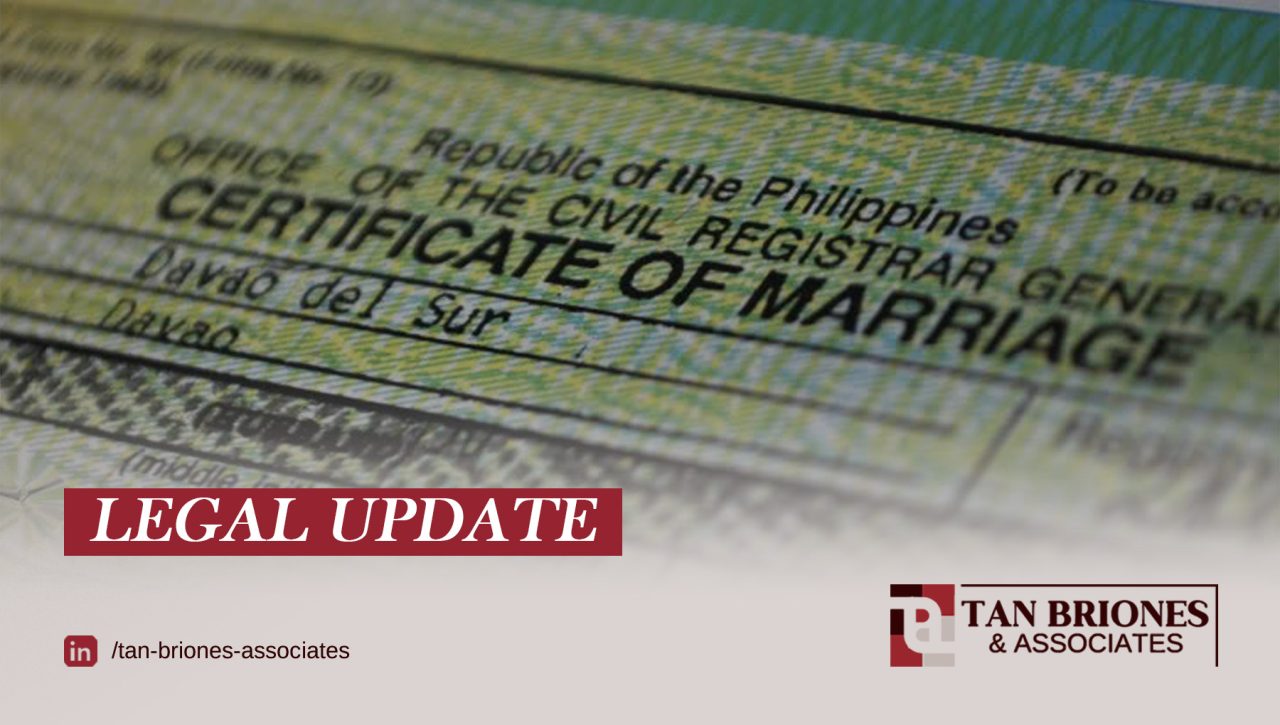
The Supreme Court (SC) has upheld the nullity of a marriage solemnized without a marriage license after finding that the couple’s affidavit falsely stated that they had lived together as husband and wife for at least five years to qualify for an exemption under the Family Code.
In a decision penned by Associate Justice Henri Jean Paul B. Inting, the SC Third Division denied the States’s petition and affirmed the Court of Appeals (CA) ruling that the couple failed to establish the required five-year cohabitation before their marriage.
“Such falsity renders the affidavit ineffectual; it does not confer exemption from the license requirement. The marriage, founded on this false declaration, is void,” the Court said.
FACTS AND ISSUE
The case stemmed from the 2009 marriage of Boots Rodel Aguirre and Alma Aguirre without a marriage license under Article 34 of the Family Code, which exempts couples who have lived together as husband and wife for at least five years and have no legal impediment to marry. Days before the wedding, they executed an Affidavit of Cohabitation stating that they had lived together as husband and wife since December 2003.
In 2013, Boots sought to have the marriage declared void, claiming that the affidavit was false. He had left for Israel to work in May 2006 and returned to the Philippines only in May 2009, shortly before the marriage.
Boots testified that before leaving for Israel, he and Alma generally lived separately and stayed together for only a few months in a boarding house shared with relatives. He also acknowledged that they did not conduct themselves as husband and wife.
The Regional Trial Court (RTC) declared the marriage void, finding that the couple failed to satisfy the five-year cohabitation requirement and that the false affidavit could not substitute for a marriage license.
The CA affirmed, similarly finding that the couple had not established the required continuous and exclusive cohabitation before their marriage.
Before the SC, the State argued that Boots’ absence for work did not interrupt their cohabitation because physical presence under one roof at all times was not required and there was no intention to sever their relationship.
The issue was whether the CA erred in upholding the nullity of the marriage after finding that the false Affidavit of Cohabitation could not serve as basis for exemption from the marriage license requirement.
RULING
The SC denied the petition and affirmed the CA ruling, sustaining the nullity of the marriage.
The Court explained that the five-year cohabitation under Article 34, an exception to the marriage license requirement that must be strictly construed, must immediately precede the marriage and be exclusive and continuous.
While physical separation does not necessarily interrupt cohabitation, the SC said there must first be proof that the couple actually lived as husband and wife and intended to maintain that relationship while apart.
The SC found that such cohabitation was not sufficiently established in this case. It also gave probative weight to Boots’ testimony despite his interest in the case, considering his statements admissions against interest because acknowledging the affidavit’s falsity could expose him to perjury liability.
“At most, the two dated exclusively and sojourned in several places. However, the fact that they intermittently and occasionally stayed in the same place does not amount to cohabitation as husband and wife contemplated by Article 34 of the Family Code,” the SC said.
Follow Tan Briones & Associates on LinkedIn for more legal updates and law-related articles.