
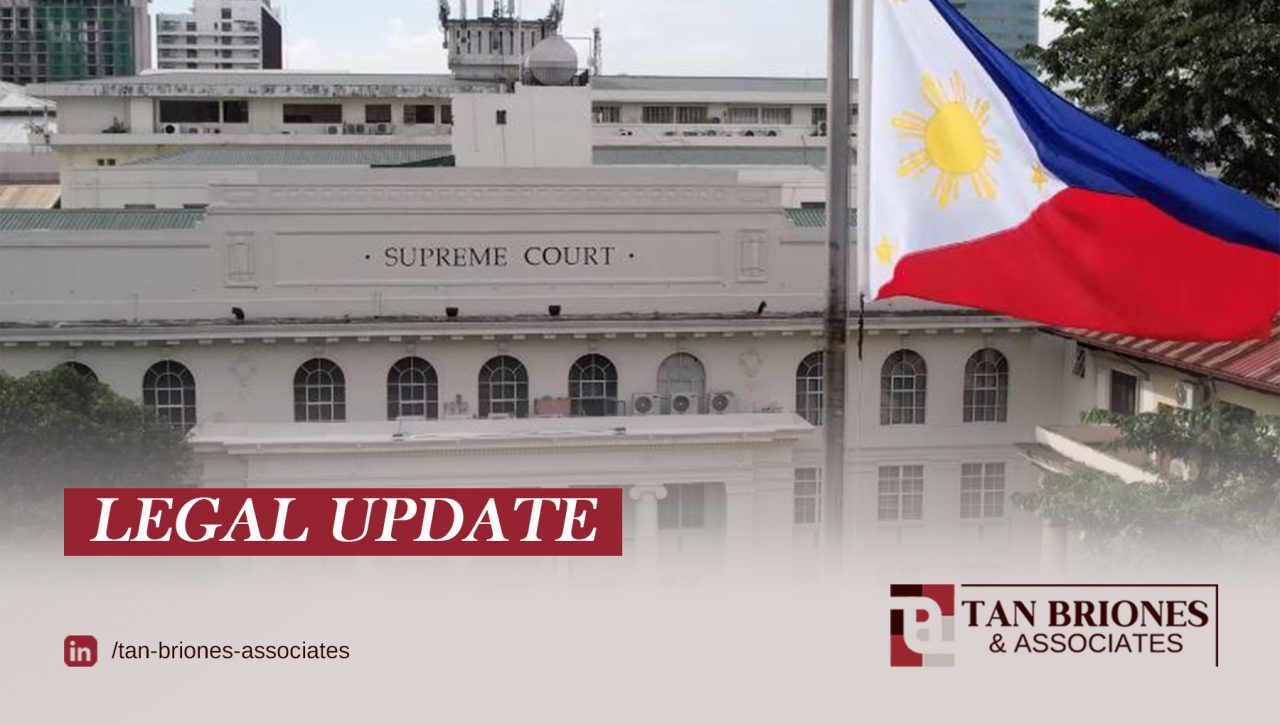
Banks must comply with lawful probate court orders requiring them to explain withdrawals from deceased depositors’ accounts and produce supporting records, the Supreme Court (SC) has ruled.
In a decision penned by Associate Justice Henri Jean Paul B. Inting, the SC Third Division affirmed that probate courts may compel banks to explain questioned withdrawals and produce supporting documents to determine which assets should be included in a deceased depositor’s estate.
“In the exercise of its jurisdiction, the RTC has the authority to clarify bank transactions affecting estate property posted by petitioner after the death of Ignacio, especially where the explanations on record appear insufficient or raise legitimate questions,” the Court said.
FACTS AND ISSUE
The case stemmed from the intestate settlement of Ignacio T. Arroyo’s estate before the Regional Trial Court (RTC) of Quezon City, where joint administrators Bernardina Arroyo Tantoco and Alicia Rita M. Arroyo sought explanations and supporting documents concerning allegedly anomalous withdrawals from his Union Bank of the Philippines (UnionBank) accounts after his death in January 2012.
UnionBank opposed the request, arguing that it had sufficiently explained the withdrawals as payments of existing obligations, transactions under a survivorship agreement, or disbursements authorized for estate taxes.
The bank also maintained that the requested email correspondence was no longer available under banking record-retention regulations.
In August 2020, the RTC ordered UnionBank to explain the questioned withdrawals and produce specified email exchanges, a directive subsequently upheld by the Court of Appeals (CA) with modification.
Before the SC, UnionBank argued that the orders exceeded the probate court’s limited jurisdiction and improperly turned the estate settlement into an adversarial proceeding.
The central issue was whether the RTC gravely abused its discretion in requiring further explanations and records concerning the withdrawals.
RULING
The SC denied UnionBank’s petition and affirmed the CA ruling, holding that the RTC acted within its jurisdiction in requiring explanations and records concerning transactions affecting the deceased’s estate.
The Court explained that probate courts may provisionally determine property ownership and ascertain account balances as of the depositor’s death to establish the estate inventory, without finally adjudicating ownership or liability.
Citing Sections 6 and 7, Rule 87 of the Rules of Court, the SC emphasized the authority of probate courts to examine persons suspected of concealing or transferring estate property and require an accounting from those entrusted with estate assets, rejecting UnionBank’s claim that its earlier explanations required no further substantiation.
The SC also held that UnionBank could not conclusively determine whether a joint account covered by a survivorship agreement formed part of the estate, noting that such agreements may be challenged if used to conceal inofficious donations, defraud creditors, or defeat compulsory heirs’ legitimes.
The Court further found that UnionBank had unilaterally offset Arroyo’s alleged liabilities against his deposits, circumventing the requirement to present creditors’ claims before the probate court, regardless of contractual provisions triggered by the depositor’s death.
“As a creditor, petitioner is required to file its claims before the probate court and cannot simply ‘skip the line’ so to speak by appropriating estate assets to satisfy its claims,” the Court said.
The SC likewise rejected UnionBank’s claim that the requested emails were irretrievable, citing its failure to demonstrate diligent recovery efforts despite producing other records from the same period.
It also noted apparent discrepancies between the amounts allegedly withdrawn for estate tax payments and those stated in the corresponding authorization, further justifying the demand for clarification.
Follow Tan Briones & Associates on LinkedIn for more legal updates and law-related articles.