

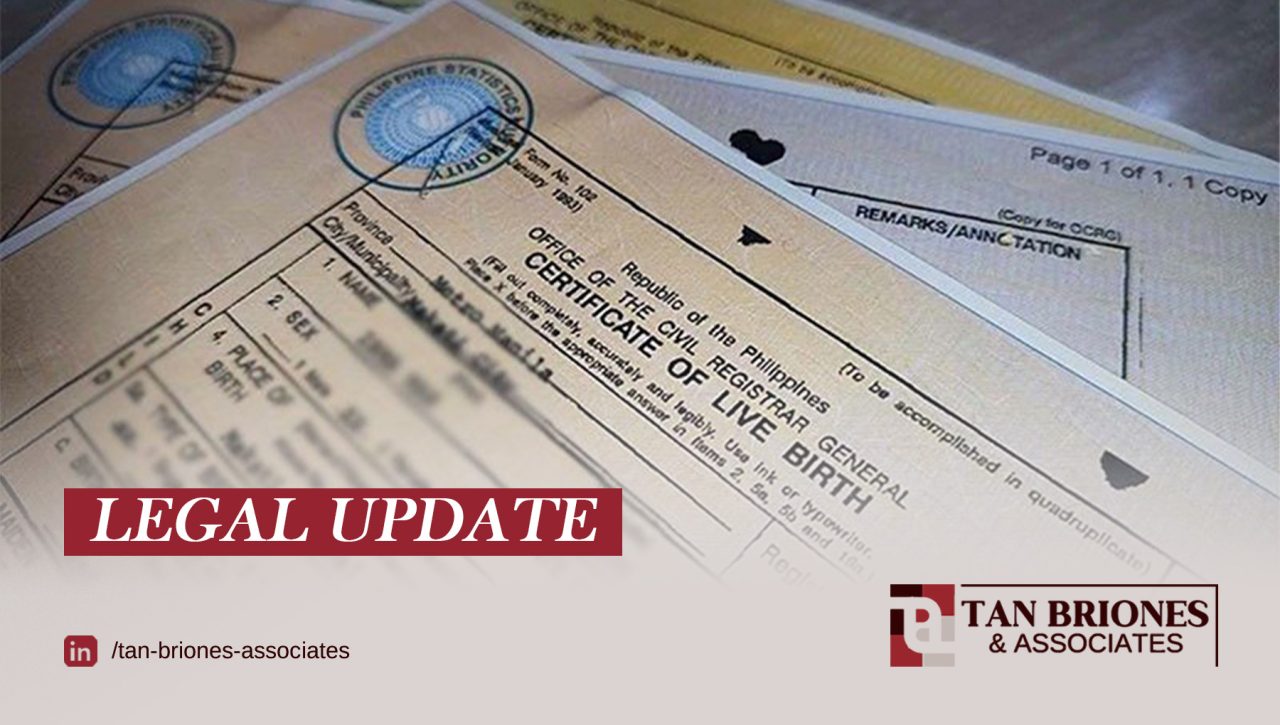
The Supreme Court (SC) ruled that a conviction for simulation of birth requires proof of intent to make a child lose his true identity and civil status.
In a decision penned by Associate Justice Alfredo Benjamin S. Caguioa, the SC En Banc acquitted a grandfather whom the lower courts had convicted of simulation of birth after a second birth certificate named him and his wife as his grandson’s parents.
The Court held that one fictitious birth registration cannot support separate convictions under Article 347 of the Revised Penal Code and Section 21(b) of Republic Act No. 8552, or the Domestic Adoption Act of 1998.
FACTS AND ISSUE
John Christopher’s original 2007 birth certificate named Christine and Leonard John Pizarro as his biological parents. After their separation, the child remained with his mother and grandparents. Leonard had earlier signed an affidavit authorizing Christine or her representative to place the child under his parents-in-law’s names, citing possible confusion because he used two names.
In 2009, a second, delayed birth certificate named Benito Somo and his wife as the child’s parents. It was later used for the child’s school enrollment and passport application. Years afterward, Leonard filed a complaint for simulation of birth.
The Regional Trial Court convicted Somo under Article 347 of the Revised Penal Code and Section 21(b) of RA 8552, while granting the other accused’s demurrers to evidence.
The Court of Appeals (CA) affirmed Somo’s convictions with modified penalties, treating the offenses as separate because it classified the Article 347 offense as malum in se and the Section 21(b) offense as malum prohibitum. It also rejected Somo’s claim that RA 11222 decriminalized simulation of birth.
Before the SC, Somo argued that RA 11222 decriminalized the offense, that his co-accused’s acquittals warranted his acquittal, and that the CA overlooked Leonard’s authorization. The Office of the Solicitor General maintained that the prosecution had proved the charges but argued that the later law impliedly repealed or modified the earlier penal provisions.
The SC considered whether the two laws created separate offenses and whether simulation of birth required criminal intent that the prosecution had to prove.
RULING
The SC granted Somo’s petition, reversed the CA’s decision and resolution, and acquitted him on reasonable doubt. It held that Article 347 and Section 21(b) punish the same offense, with Section 21(b) clarifying how simulation of birth is committed rather than creating a separate crime.
The Court classified simulation of birth as malum in se and found that, although the false registration was established, the prosecution failed to prove the required criminal intent. It cited the intact original birth certificate, Leonard’s authorization, the second certificate’s use for school and passport needs, the absence of personal gain or injury, and Somo’s later adoption and rectification petition as evidence of good faith. The Court said the child’s best interests may inform that assessment but are not a separate defense.
However, the Court rejected implied repeal, explaining that RA 11222 created a conditional process for rectifying records and obtaining an exemption, while RA 11642 continued to penalize fictitious birth registration. It did not decide whether Somo qualified for the exemption because his acquittal rested on the failure to prove criminal intent. The Court limited its broader discussion of malum in se and malum prohibitum to this case, saying future classifications must consider each law’s purpose and language.
“Absent proof beyond reasonable doubt that the simulation was undertaken with a design to cause this harm, the punitive force of the law cannot be triggered,” the Court stated.
Follow Tan Briones & Associates on LinkedIn for more legal updates and law-related articles.