
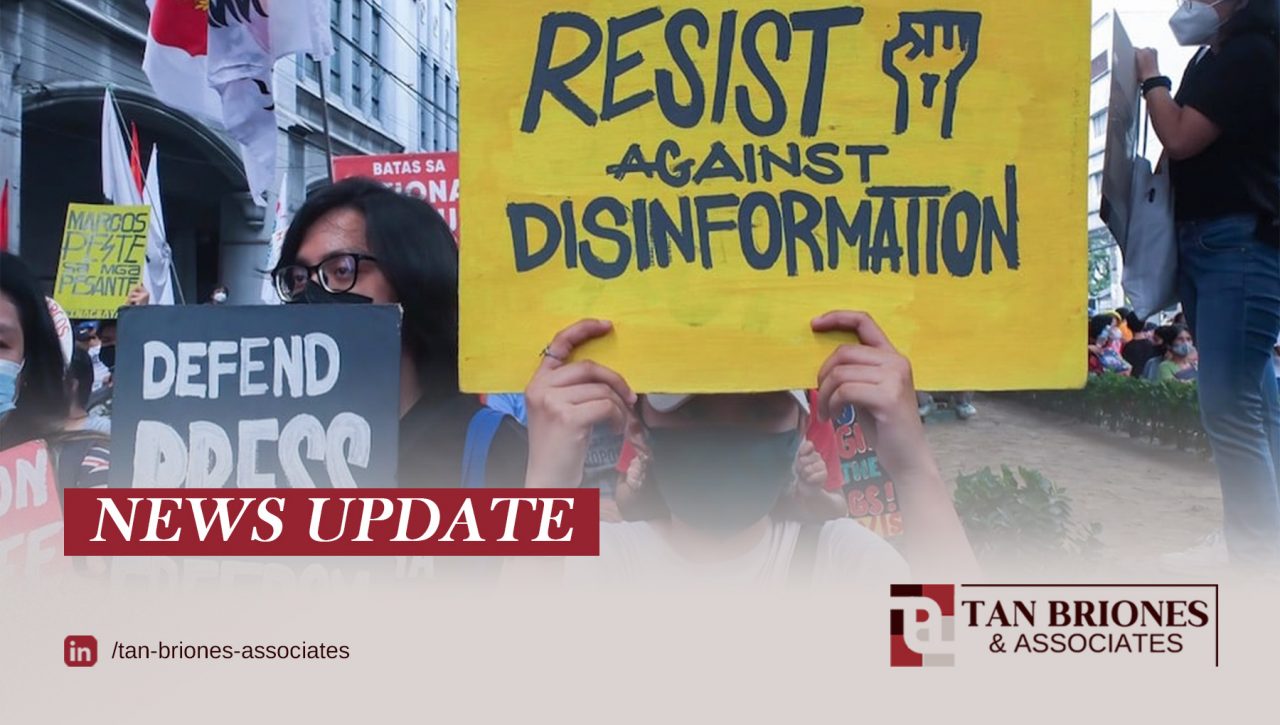
A coalition of media organizations and journalists has urged Congress to reject pending anti-disinformation bills, arguing that the proposals would expand government authority over speech while failing to address the structural drivers of disinformation.
In a joint statement, the Movement for Media Safety Philippines (MMSP) and dozens of media organizations and journalists said House Bill No. 9465 and its Senate counterpart mistake “the symptoms for the disease” by criminalizing expression instead of addressing the political, economic, and technological systems that enable coordinated information manipulation.
The coalition said it supports decisive action against disinformation but argued the pending measures are “the wrong response to a real problem.”
“We support decisive and effective action against disinformation,” the statement said.
“However, we believe the pending anti-disinformation bills (HB 9465 and its equivalent in the Senate) are the wrong response to a real problem,” it added.
Among its concerns, the coalition said existing laws already provide remedies for offenses such as libel, fraud, identity theft, election offenses, and cybercrime-related violations, making new criminal restrictions on protected expression unnecessary without first assessing the implementation of current laws.
The group also said criminalizing speech would primarily target individual users while failing to hold accountable the platforms, algorithmic systems, and coordinated networks that manufacture and amplify disinformation.
“Criminalizing content is a blunt, disproportionate, and ultimately ineffective response that ignores the architectural roots of information disorder,” the statement said.
Instead, the coalition urged lawmakers to strengthen platform accountability by requiring greater transparency in recommendation algorithms, political advertising, and coordinated inauthentic behavior, alongside independent audits and public oversight.
It also warned that vague definitions of prohibited speech could invite selective enforcement and legal uncertainty, while allowing the government to become “the ultimate authority on the truthfulness of speech concerning its own actions.”
The statement argued that transparency, timely access to public information, independent journalism, and democratic debate remain the most effective safeguards against falsehoods.
As an alternative, the coalition called for a rights-based strategy that includes passing a Freedom of Information law, regulating the financing of coordinated disinformation campaigns, requiring greater platform transparency, supporting independent journalism and fact-checking, expanding media and digital literacy, promoting research on the country’s information ecosystem, and strengthening collaboration among government, media, civil society, academia, and technology companies while respecting constitutional rights.
The statement has been endorsed by numerous media organizations, journalism groups, academic institutions, and individual journalists nationwide.
Follow Tan Briones & Associates on LinkedIn for more legal updates and law-related articles.